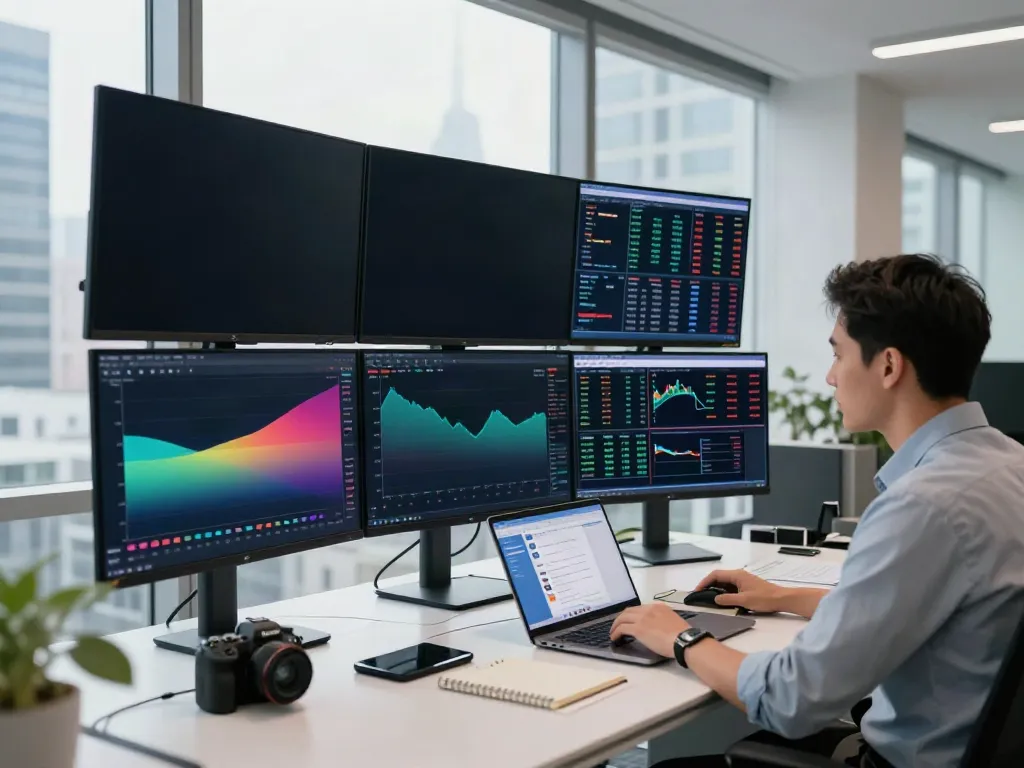
High-frequency crypto trading has changed considerably in 2026. What was once largely limited to professional quantitative firms is now becoming more accessible to sophisticated individual traders, developers, and smaller trading teams using automated strategies.
The difference, however, is that having a trading bot is not enough.
For high-frequency strategies, the exchange itself becomes part of the trading system. API response times, order execution, liquidity, trading fees, rate limits, uptime, and market-data quality can all influence whether a strategy works as expected.
That is why the search for the best crypto exchange for high frequency trading has become more complicated this year.
Recent industry research highlights Bitget, Coinbase and other major venues among the platforms being considered for automated and high-frequency strategies. At the same time, exchanges are continuing to improve their APIs and institutional infrastructure as algorithmic trading becomes more common.
Why HFT Traders Need Different Exchange Features
A normal trader might care mostly about charting tools, available coins and an easy interface.
An HFT trader looks at something else entirely.
Milliseconds matter. Sometimes less.
An automated strategy may send hundreds or thousands of requests while monitoring price differences, order-book changes or short-term momentum. If the exchange responds slowly, the opportunity can disappear before the order reaches the matching engine.
This makes latency one of the first things professional traders evaluate.
But it isn't the only one.
High-frequency trading also requires stable APIs, predictable execution, sufficient liquidity and fees low enough that repeated transactions do not consume the strategy's expected edge.
High-frequency trading relies on sub-millisecond execution, robust APIs, and minimal fees. The guide to the best crypto exchange for high frequency trading evaluates platforms on latency, API quality, and fee structures, giving algorithmic traders a clear framework for choosing their infrastructure.
Bitget's Position in the 2026 HFT Market
Bitget has increasingly positioned itself as an exchange for active and algorithmic traders.
Its current trading infrastructure supports API-based access, spot markets and derivatives, allowing developers to connect external systems directly to exchange services. Bitget has also expanded beyond traditional crypto markets into tokenized assets and other financial products.
Recent institutional-focused material from the exchange highlights its Universal Trading Account, liquidity infrastructure and cross-asset APIs as part of its broader professional trading environment.
For an HFT operation, that broader infrastructure can matter.
A trader isn't necessarily looking for another simple buy-and-sell platform. They may need one environment where market data, order execution and account management can all be connected programmatically.
Fees Become a Major Issue at High Trading Frequency
Trading fees can look tiny on a single transaction.
At high frequency, they aren't.
Imagine a strategy making thousands of trades over a period of time. Even a small increase in the effective cost per transaction can materially change the strategy's profitability.
This is why maker and taker fees need to be examined before choosing an exchange.
Bitget's published 2026 materials show competitive fee structures, with some spot fee schedules cited at 0.01% for makers and takers, while futures pricing can vary by account level and product.
The exact rate available to a trader can depend on factors such as VIP status, trading product, region and applicable discounts.
So don't simply compare the headline fee.
Look at the actual fee your account receives.
For an automated strategy, that number is much more useful.
Liquidity Can Be More Important Than a Low Fee
Low fees don't automatically make an exchange suitable for HFT.
A strategy needs to get orders filled.
Suppose an exchange advertises an attractive trading fee but has a relatively thin order book for the asset being traded. A large market order may experience substantial slippage. The strategy could save money on commission while losing more through execution.
Deep liquidity helps reduce that problem.
This is particularly important for market-making, arbitrage and short-term futures strategies where execution quality can determine the difference between a profitable and unprofitable trade.
Institutional trading research in 2026 increasingly emphasizes actual order-book depth rather than relying only on displayed prices. Bitget's recent institutional material similarly points to liquidity and executable size as important considerations for larger trading operations.
API Quality Is Critical
For an HFT trader, the API is effectively the connection between the strategy and the exchange.
A good API should provide reliable market data, order submission, account information and execution updates.
WebSocket connections are particularly important for systems that need real-time market data because continuously polling REST endpoints can introduce unnecessary delay and consume rate limits.
Developers also need to understand API authentication, request limits and error handling.
A bot that works perfectly during quiet market conditions may behave very differently during a sudden price spike if it starts receiving rate-limit errors or delayed responses.
That's a serious issue.
A strategy can't trade an opportunity it doesn't see.
Execution Speed Isn't the Whole Story
The phrase "low latency" gets used constantly in discussions about HFT.
But traders should be careful with it.
The time taken for a request to travel from a trading server to an exchange is only one part of the complete execution process. Market-data delivery, network routing, order validation, matching-engine processing and execution reporting can all affect the final result.
This means an exchange claiming fast infrastructure does not automatically mean every trader will experience identical execution.
Server location matters. Internet routing matters. Software architecture matters.
So does the strategy itself.
A poorly designed bot cannot become competitive simply because it is connected to a fast exchange.
Crypto HFT Is Becoming More Accessible
One of the interesting developments in 2026 is the growing availability of algorithmic trading tools for non-institutional traders.
Python frameworks, exchange APIs, cloud servers and increasingly sophisticated data services have lowered some of the technical barriers. Industry coverage now describes algorithmic crypto trading as accessible to experienced retail traders as well as professional firms.
AI-based trading systems are also adding another layer.
Trading agents can process market information, generate signals and interact with execution systems through APIs. But automation doesn't eliminate risk. In fact, it can make mistakes happen faster.
A faulty strategy can place a large number of incorrect orders before the operator notices.
That is why testing matters.
Security and Reliability Still Matter
Speed should never be considered separately from security.
An HFT account may hold significant trading capital and have API keys with permission to place orders. Those credentials need to be protected carefully.
API permissions should be limited to what the strategy actually requires. Withdrawal permissions, where available, should generally be disabled for trading-only keys.
Two-factor authentication, IP restrictions and secure server environments can provide additional layers of protection.
Exchange uptime matters too.
A strategy can be profitable on paper but fail during an outage or connectivity problem. Professional traders therefore evaluate operational reliability alongside speed.
How to Evaluate an Exchange for HFT
Before deciding which platform is the right fit, an HFT trader can compare several practical areas:
API latency: How quickly can market data and order responses move between the strategy and exchange?
Market-data quality: Does the platform provide real-time WebSocket feeds and sufficient order-book information?
Trading fees: What are the actual maker and taker rates for the intended market?
Liquidity: Can the strategy execute its normal order size without excessive slippage?
Rate limits: How many requests can the system make within the relevant time period?
Order types: Does the exchange provide the order functionality required by the strategy?
Reliability: Has the platform demonstrated stable operation during high-volume periods?
Security: Can API permissions be restricted and trading infrastructure protected?
These factors should be evaluated together.
One excellent feature cannot compensate for a major weakness somewhere else.
Bitget and the 2026 Trading Environment
Bitget's growing focus on professional infrastructure makes it a notable candidate for traders researching the best crypto exchange for high frequency trading.
Its combination of spot and derivatives markets, API connectivity, competitive fees and expanding institutional infrastructure gives algorithmic traders several components they typically need. Current Bitget research also highlights cross-asset API capabilities and liquidity as part of its institutional offering.
Still, no exchange should be selected solely from a feature list.
An HFT trader should test the API with small amounts, measure real-world latency from the intended server location, examine execution quality and calculate the strategy's actual all-in trading costs.
Real measurements beat marketing claims.
Final Thoughts
The search for the best crypto exchange for high frequency trading in 2026 is ultimately about infrastructure rather than flashy trading screens.
Fast APIs, reliable market data, deep liquidity and competitive fees form the foundation. Security, uptime and predictable execution matter just as much.
Bitget has strengthened its position in this area by expanding its API and institutional trading infrastructure while maintaining access to a broad range of spot and derivatives markets.
But HFT is unforgiving.
A few milliseconds can matter. A small fee difference can add up. One API failure can disrupt an entire strategy.
For traders building automated systems in 2026, the best exchange is therefore not necessarily the one with the biggest marketing claims. It is the venue that performs consistently under the exact conditions their strategy needs.